Could Chenab Plan Avert Jammu Massacre?
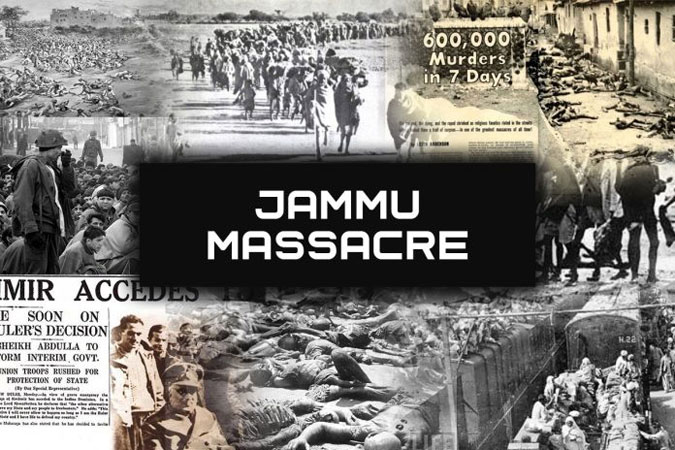
Every year, November 6 reminds us of the plight of tens of thousands of Kashmiri Muslims from Jammu, who were beguiled into in a vicious trap and then slaughtered in cold blood. Those innocent and clueless Muslims, promised to facilitate their migration to their other home – Pakistan, never saw the day again. They did not have any idea that a dark and gruesome fate awaited them; thousands of old, young, children and women were massacred by the Indian army and the RSS.
After the planned savage butchery unleashed by Indian army and the RSS, thousands of Muslim women were abducted, raped or put to swords. Amongst those unfortunate daughters, was the daughter of Chaudhry Ghulam Abbas, a notable Muslim leader, who was kidnapped during the mass massacre, and later retrieved, thanks the efforts of Sheikh Abdullah.
Subsequently, to add to the woes of bleeding Muslims, the doctors at the Government Hospital in Jammu were directed not to treat injured ,bleeding Muslims. In actual fact, every effort was made to compound the grief of Muslims. Allama Iqbal (so perceptively) mourned those moments.Ye Ghari Mehshar Ki Hai, Tu Arsa’ay Mehshar Mein Hai (This moment is the Day of Judgment; you are in the field of Judgments’ Day!).’
Despite the passage of 74 years, the souls of those martyrs haven’t received any solace, for neither the sacrifices of Jammu have been heeded to, nor a new day has dawned in Kashmir. On the contrary, trauma of Kashmiris has aggravated and their scars have deepened further. The Jammu massacre offers some significant connections with the present state of affairs in Kashmir.
The catastrophic 6 November calls for some pertinent questions. When Kashmiris in Jammu were ensnared by the RSS marauders under patronage of the Indian army, here in Pakistan, under backing of Sir Zafarullah,A-Furqan Brigade was formulated . To train and equip Al- Furqan Brigade, 16 Punjab Regiment, stationed in Sialkot, was assigned the responsibility. The regiment in question trained and equipped Al- Furqan Brigade and dispatched them to Jammu border to assist the Muslims trapped in Jammu, waiting to cross into Pakistan.
Nevertheless, sadly, there is no mention of role of Al-Furqan Brigade in the annals of the history. The entangled Muslims in Jammu kept on waiting (in the vale of concentration and death) for assistance of Al-Furqan Brigade positioned merely around 12 kilometers away. In the killing ground, the Indian army and the RSS unleashed chilling carnage, akin to holocaust. But, Al-Furqan Brigade did not act; it maintained mysterious silence (as planned, perhaps). Why did the brigade not act: to guard and guide the entombed Muslims in Jammu to Pakistan? Where did their weapons disappear? Later, why wasn’t there any inquiry into criminal role of Al-Furqan Brigade conducted?
Many strategists and military planners even question the intent of making the Al -Furqan Brigade. In fact, they see it as a crafty plan to ensure massacre and mayhem and facilitate the Indian army, let the Kashmiri Muslims be trapped and exterminated. They consider the formation of Al -Furqan Brigade a malevolent plan to appease India and ensure murder of Kashmiri Muslims.
Also, it is an unfortunate fact that many are not aware of the Chenab Plan. It is really important to mention that Chenab plan was very thoughtfully devised by General Muhammad Zaman Kiyani and Brigadier Raja Habib who planned to equip the mujahedeen and take control of Banihal Pass which forms the main gateway to the valley of Kashmir from the Indian plains.
General M.Z. Kiyani and Brig. Raja Habib strategized to ensure total blockade to the Indian troops to prevent their entry to Kashmir. To actualize that idea, there were 62 thousand trained soldiers in Mirpur, a fact mentioned by Sardar Ibrahim Khan in The Kashmir Saga. Those soldiers were demobilized after having served in British Indian Army and well trained to use 303 rifles. Those weapons were available in police stations of Sialkot, Gujrat, Gujranwala and Jhelum.
On the Indian side, Maharaja had only 9 Infantry Battalions and one Horse Cavalry and no tank. The Indians could not afford to drop many troops by air, which would indeed make them vulnerable to mujahedeen. The absence of reinforcement from Banihal Pass due to barricade (as planned) could have trapped and deeply demoralized the forces of Maharaja, giving enormous boost and tactical advantage to mujahedeen.
But mysteriously, the minister of foreign affairs which was looking at Kashmir issue hastened to erect Al -Furqan Brigade. That step defused the Chenab Plan and paved a way to genocide to unfold. Prima facie, Sir Zafarullah Khan did it a malicious purpose: to appease the Indians. It is widely believed that if Chenab plan were given a go ahead, Jammu massacre could have been averted and history of Kashmir could be different.
Equally upsetting is absence of Kohala Massacre from history and mainstream narrative. Again it is significant to highlight that Kohala Massacre was unleashed by Dogra. Kohala is a bridge that connects Kashmir with Murree. In a wicked plan, the then Dogra army encouraged the Muslims who wanted to go to Pakistan, promising them support and facilitation. Following it, thousands of Muslim men, women and children riding in trucks reached Kohala, where Dogra Army had mounted machine guns, ready to slay them. Dogra Army annihilated hundreds and abducted scores of them to rape and torture them further. Amid chaos, to save their honor, countless women splashed into the Jhelum River, sweeping scars of savagery and ensuring sanctity of their honor, and never heard of or mourned again. Could the Chenab Plan avert that mass calamity? Did Sir Zafarallah’s unholy plan share the responsibility for the spill of that blood at Kohala too? Some courageous historians and leaders need to do serious soul searching to demystify it, addressing these significant questions.
The writer is a freelance columnist and reached at sliklight55@gmail.com